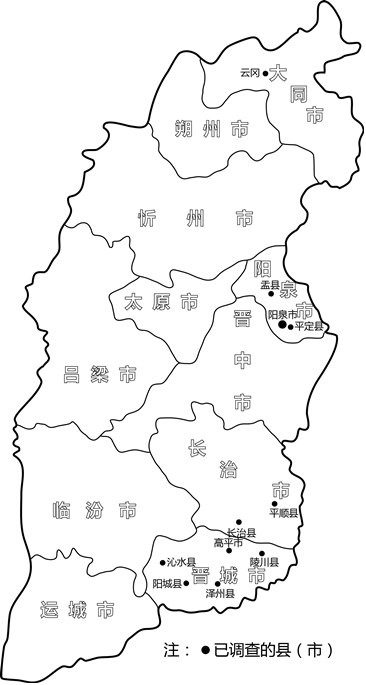
Crucible smelting was widely practised in Shanxi from the Song period to the 20th century, and archaeological sites related to crucible smelting are found throughout the province. These are especially concentrated in the southern and central Taihang Mountains (southern and eastern Shanxi), especially in the prefectures of Jincheng 晋城 and Yangquan 阳泉. The distribution of crucible smelting sites in more than ten counties and districts in these two prefectures was investigated in several years of fieldwork. The counties investigated are indicated on the map.
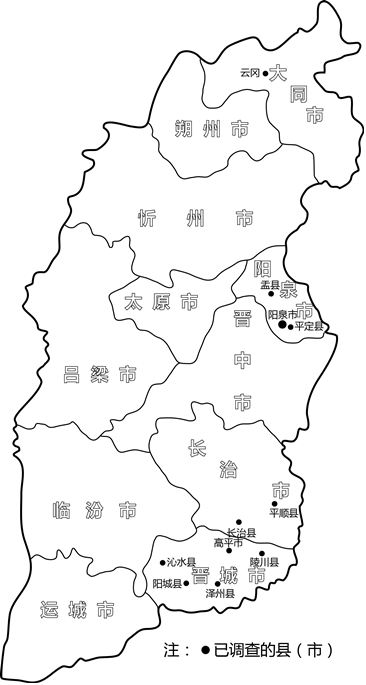
Counties surveyed in Shanxi province

Part of the Beishe iron-smelting site in Zezhou County
泽州县北社冶铁遗址局部

Hougoucun crucible iron-smelting site in Gaoping Municipality
高平市后沟村坩埚冶铁遗址
From the Song to the 20th century, the production of iron by crucible smelting in the Taihang Mountains was enormous. Especially in regions that were rich in coal and iron resources, there are production centres with ancient smelting and casting traditions. The crucibles used in iron smelting can be used only once, and those used in iron casting can be used at most twice. Furthermore, crucible smelting produces much more slag than blast-furnace smelting as well as many more discarded crucible fragments. For these reasons the slag heaps at crucible smelting sites in the southern and central Taihang Mountains can be very large indeed. The table below lists some typical sites.
| No. | County or district | Name of site | Site description | Notes |
|---|---|---|---|---|
| 1 | Zezhou, city and county 泽州县及城区遗址 |
Dayang site 大 阳冶铁遗址 |
Mostly discarded crucible fragments. some coal, ore, and discarded furnace bricks. | There are many slag heaps around the town of Dayang, especially to the south and west. |
| 2 | Dongxiejiang site 东谢匠冶铁遗址 |
The slag heap includes furnace slag, iron-smelting crucible fragments, and some relatively complete crucibles. | ||
| 3 | Beishe site 北社冶铁遗址 |
The slag heap includes crucible fragments and furnace slag, also some furnace bricks and potsherds. On the top of the slag heap, an old house, a millstone, and other items of daily use. | ||
| 4 | Gaoping County 高平县遗址 |
Weidong Shangcun site 尾洞上村冶铁遗址 |
A heap of crucible fragments with some furnace slag. | |
| 5 | Gukoucun site 谷口村冶铁遗址 |
There is furnace slag on hills to the east and west of the village. In the village there is slag everywhere. Some houses are even built atop slag heaps. | In the furnace slag can be seen large pieces of fining slag. This slag has a relatively high iron content. The villagers have for many years processed this and sold it. | |
| 6 | Hougoucun site 后沟村冶铁遗址 |
The slag heap is a mixture of furnace slag and crucible fragments. | Judging from the form and colour of the of the crucible fragments, this site may be comparatively early. | |
| 7 | Duoze site 朵则冶铁遗址 |
The slag heap spreads from a hill down into a ravine and partly levels the ravine. The heap includes crucible fragments, iron-smelting slag, fining slag, and pieces of cast iron. | Older people in the village stated that this was the original location of the Sanshenglu 三盛炉 cutlery factory in the Qing and Republic periods. | |
| 8 | Xi Lijiazhuang site 西李家庄冶铁遗址 |
Judging from the visible strata, the slag heap has sheered off to the east and west. At an early period the fallen slag filled up a ravine and levelled the surface. At a later period a furnace was built for smelting on top of the slag heap; furnace fragments and crucibles remain. | ||
| 9 | Chunzhu-zhuang site 椿树庄冶铁遗址 |
Slag has fallen several times from the northern slope into a ravine, leaving a four-step plateau. The slag heap consists primarily of crucible fragments and smelting slag; there is also some fining slag. | ||
| 10 | Qinshui County 沁水县遗址 |
Tanhuagou site 探花沟冶铁遗址 |
The areal extent of the slag heap is difficult to determine. From visible sections it appears that it is 30 metres high at the highest point. The slag heap includes crucible fragments, furnace slag, and ashes. | |
| 11 | Shijinggou site 石井沟冶铁遗址 |
Numerous smelting sites. Remains include ditches filled with slag, cave dwellings constructed with stones and crucibles, a small Taoist temple in which the workers worshipped, a stone bridge for transportation of iron goods, and various objects of daily use. | ||
| 12 | Haoli site 号里冶铁遗址 |
Within the site furnace slag and crucible fragments have fallen from the top of a hill to cover the slopes. Because of the passage of a long time, the stratum of furnace slag is covered by 50–100 metres of earth. | ||
| 13 | Lingchuan County 陵川县遗址 |
Xijie site 西街冶铁遗址 |
Three relatively large heaps of furnace slag. | |
| 14 | Cuicun site 崔村冶铁遗址 |
Because of land development only a part of the slag heap remains. From the vertical section it appears that it consists of crucible fragments and smelting slag. | ||
| 15 | Donggou iron-smelting site 东沟冶铁遗址 |
Furnace slag and crucible fragments scattered on a hill. | ||
| 16 | Guojiagou site 郭家沟冶铁遗址 |
Judging from a partial vertical section, the slag heap is 1–2 metres thick, mostly crucible fragments and smelting slag. | ||
| 17 | Pushui site 蒲水冶铁遗址 |
Some slag-heap strata are up to 3 metres thick. Mostly crucible fragments and furnace slag. | ||
| 18 | Beiye site 北冶冶铁遗址 |
The site includes smelting slag and crucible fragments. Some slag-heap strata are up to 2–3 metres thick. At the top of a cliff is a rectangular iron-smelting furnace with width 1–1.5 metres, height 1–1.5 metres. At the bottom of the furnace are crucibles and furnace slag. | ||
| 19 | Sijialing site 司家岭冶铁遗址 |
In various ravines spread over a broad area are small hills of slag. From visible sections it appears that these are 3–5 metres thick. The slag heaps contain mostly crucible fragments, smelting slag, and fining slag. | ||
| 20 | Sibei site 寺背冶铁遗址 |
Some slag heaps are as thick as 10 metres, mostly crucible fragments and furnace slag. | ||
| 21 | Beiluhe site 北炉河冶铁遗址 |
Some slag heaps are as thick as 10 metres, mostly crucible fragments and furnace slag. | ||
| 22 | Yangcheng County 阳城县遗址 |
Beianyang site 北安阳冶铁遗址 |
Primarily agglomerations of furnace slag, some including crucible fragments. | |
| 23 | Yangquan Municipality suburbs 阳泉市郊区遗址 |
Sanquan site 三泉冶铁遗址 |
Among the crucible fragments in the slag heap, crucible bottoms are relatively common. There are few large slag pieces, and there are relatively pure small pieces of glassy slag. | |
| 24 | Hedi site 河底冶铁遗址 |
Spread through the village are small furnace-slag heaps, and there are no large concentrations of slag. On the roofs of houses can be seen used foundry crucibles. | ||
| 25 | Sandu site 三都冶铁遗址 |
The slag heap consists primarily of fragments of smelting and foundry crucibles. There is also slag and iron that has flowed from crucibles, and large slag pieces that have solidified around crucible fragments. | ||
| 26 | Pingding County 平定县遗址 |
Lishe site 里社冶铁遗址 |
In the village there are no obvious furnace-slag heaps, but in a few places scatters of crucibles and furnace slag. The villagers search through the slag heaps for crucibles and use them as construction material. Crucible walls can be seen everywhere. | |
| 27 | Zhongshe site 中社冶铁遗址 |
As above. | ||
| 28 | Yuxian County 盂县遗址 |
Qingcheng site 清城冶铁遗址 |
There are some heaps of crucibles, from their exterior form probably foundry crucibles. |
The sites listed here have not been properly excavated, and are mostly known only from surface finds, so it is very difficult to date them.
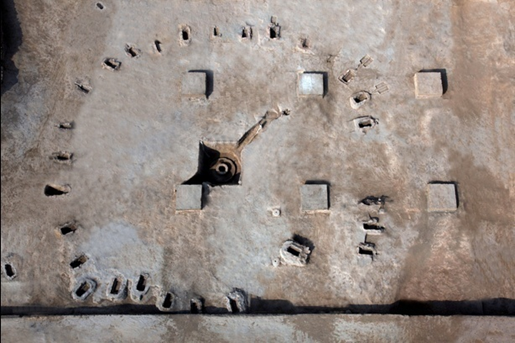
A foundry site at Kuling in the Yungang Grottoes area
云冈石窟窟顶铸造遗址。
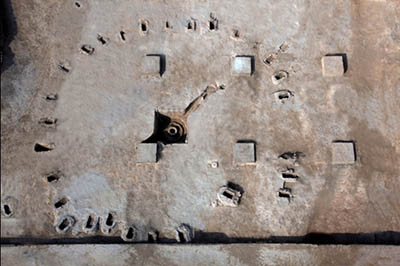
Foundry site at the Yungang Grottoes (entire site)
云冈石窟铸造遗址(全景图)
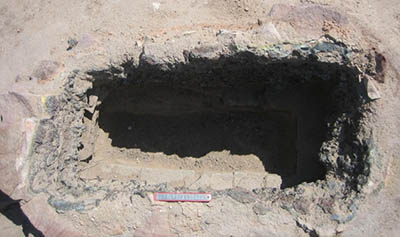
Outside view of furnace no. 3.
3号炉外形
For the time being the only proper excavation of a crucible iron-production site in Shanxi is a foundry site at Kuding in the Yungang Grottoes area 云冈石窟窟顶. Here 30 iron-casting furnaces are distributed in a circle. Numerous crucibles have been unearthed. It can be determined that this was a crucible iron foundry rather than a smelting site, but the installations for the traditional technologies of crucible smelting and casting are basically the same. Study of the crucible iron-foundry furnaces on the site can therefore be useful for an understanding of the crucible furnaces of the time and increase our knowledge of the crucible smelting technology of the period.
The furnaces at this site are semi-subterranean with a slanted tuyère directed from the surface towards the bottom. The bottom part is rectangular, lined with bricks. In the middle there is no slag, so this must be where a grate was placed. The walls of the upper part are made of sandstone; on the inside there is a layer of slag. See the excavation report for details.